«Rodolo placentós pel segle XI»
«Vilamajó has designed a second artistic itinerary with two artistic interventions in Pont de Suert and three in 11th-century Romanesque churches that are part of the Romanesque ensemble of the Vall de Boí, specifically Santa Eulàlia d’Erill la Vall, Sant Joan de Boí, and Sant Feliu de Barruera, where Marco Noris, an Italian artist residing in Catalonia, has made one of the most successful contributions to a festival that aims to dialogue contemporary creation with the country’s heritage. Noris is an artist who walks, who needs to tread the terrain to commune with the landscape. In the church of Barruera, he has hung a tapestry that blends and confuses with the stones of the apse. The artist works with a very resistant silk paper, which, during his excursions through the forest, he has brought into contact with the earth and water, with the mud. Noris explained that during a long stay at the Centre d’Art i Natura de Farrera, where he did a residency, he had a very resistant paper brought from Germany. With the intention of reproducing on the paper what you see on the ground when you walk through the mountains, Noris buried this paper underground for three weeks. The tapestry-altarpiece installed in the church of Sant Feliu is the materialization of the earth on paper, an exercise in geotaxidermy that integrates perfectly into the stone apse of the Romanesque. It is as if he had skinned the earth to transfer it onto paper. It is no coincidence that the title of the piece is precisely Skins.
»With his intervention, Noris wanted to transform this place of worship so that everyone could feel welcome, beyond the religion that each one may have. The day the festival’s photographer entered the church for the first time to photograph his installation, she did not see the tapestry, so integrated it is among the stones of the Romanesque. We are not far from the material painting with which Tàpies conveyed the expression of agony on the peeling walls.»
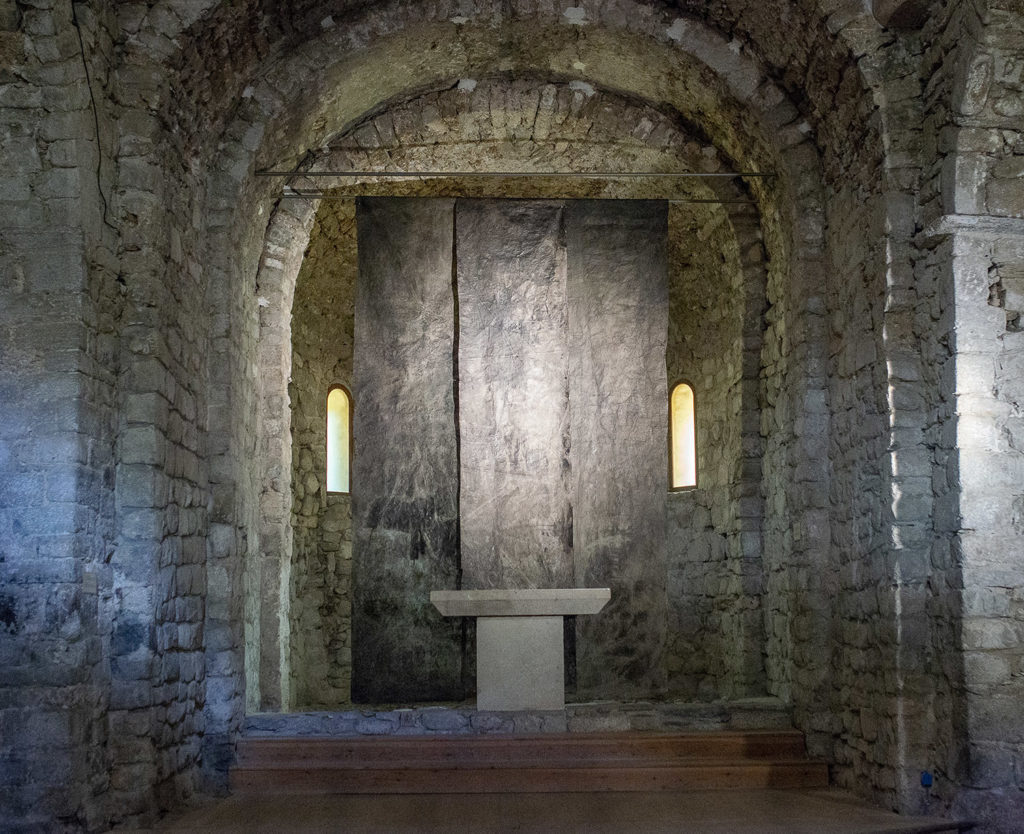
Image: Iolanda Sebé