Body-Ebro. The river as body, archive, and border
To Norma, body Ebro
Body-Ebro is an artistic project that explores the river as a body, a border, and an archive. It is based on a walking journey from the source of the Ebro River (Cantabria, Spain) to its mouth in the Mediterranean, establishing a dialogue between the artist-body and the river-body as a space of collective memory. Inspired by Sequere, a previous project by Marco Noris, Body-Ebro proposes a real-time reading of the territory, where the act of walking activates a new embodiment of memory], linking geography, history, and climate emergency.
Body-Ebro is a project by Marco Noris, conceived and developed in collaboration with the psychoanalyst Celeste Reyna and produced in partnership with Lo Pati.
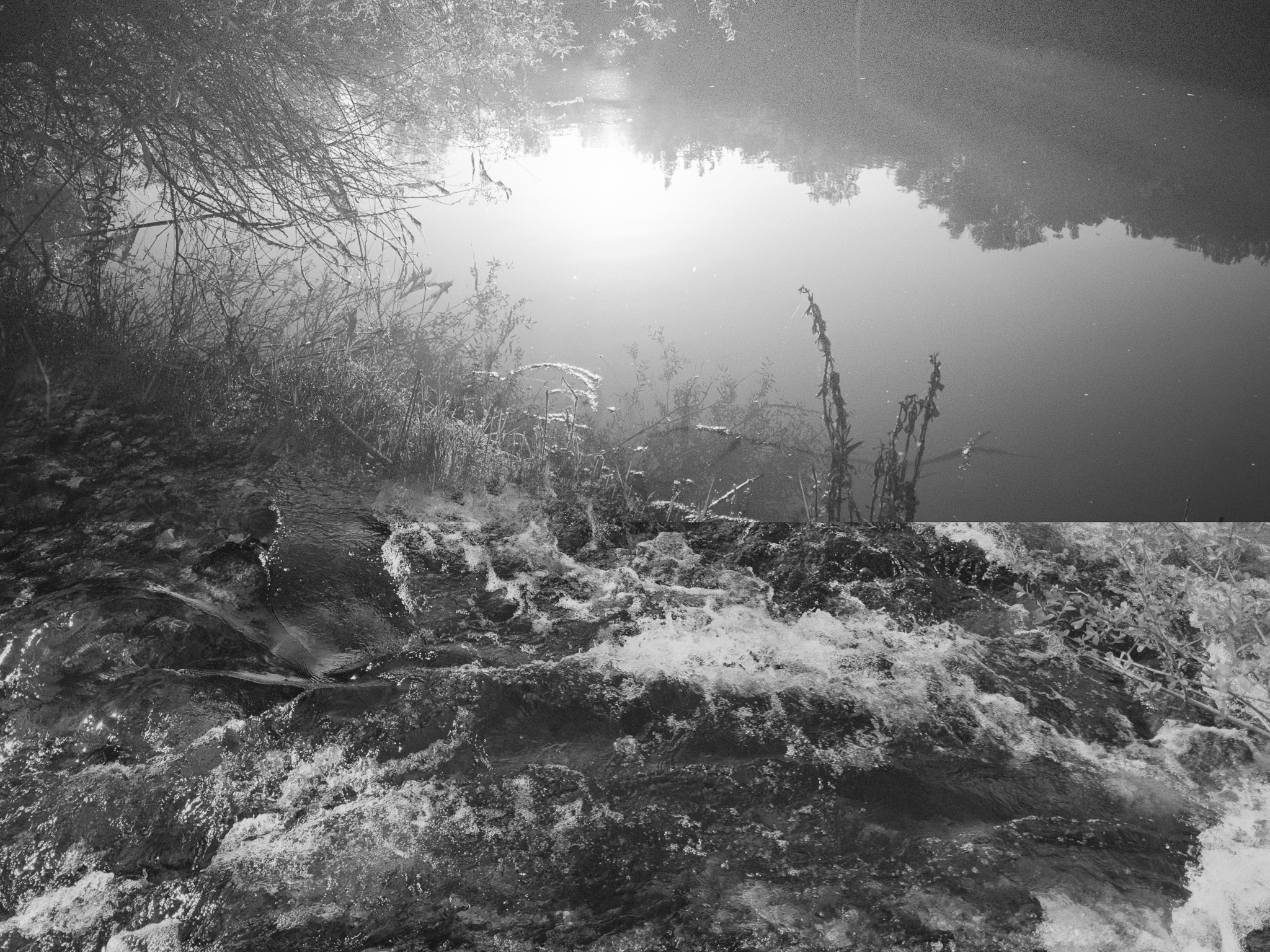
Body-Ebro1 is an artistic project that explores the river as a body, a border, and an archive. It is based on a walking journey from the source of the Ebro River (Cantabria, Spain) to its mouth in the Mediterranean, establishing a dialogue between the artist-body and the river-body as a space of collective memory. Inspired by Sequere, a previous project by Marco Noris, Body-Ebro proposes a real-time reading of the territory, where the act of walking activates a new embodiment of memory2, linking geography, history, and climate emergency.
Rivers, as dynamic systems, accumulate layers of natural and cultural history, functioning as living archives where geological, ecological, and human narratives are deposited. They are archives of memory, time, and landscape—not only through their fluvial sediments but also through the human communities that have grown around them. Rivers are also anthropocenic records, accumulating plastics, chemicals, and waste, as well as poetic archives, made of myths and metaphors.
The River-Body
The river is both body and time, a convergence of waters, tributaries, torrents, and streams that run and unfold simultaneously. The river is the union of space and time, an organism whose physical and temporal dimensions are interwoven in a single, continuous flow—occurring at once in different places and at different moments: the water flowing through the valley moves in unison with that of the mountain.
The river is time and body. “We carry the river, its body of water, in our body”3, as a continuous event that also unfolds inside us. We share the same matter and the same dynamics: the water that runs through the riverbed also circulates through our body. But “body and water are not two unlike things—they are more than close together or side by side. They are same—body, being, energy, prayer, current, motion, medicine.”4.
The river-body is not a fixed entity, but an event in cyclical, constant, and impermanent motion—a stage for the eternal cycle of things. The river-body bears a name, yet it is not a singular entity: it is the sum of all the waters that compose its body. Just like human identity, the self does not exist as something absolute—we are the totality of the waters that dwell within us.
Cos d’Ebre is a project that immerses itself in the sacredness of the natural world, contributing to a new philosophy of the Earth by weaving together the river and the human as organisms sharing the same current of life within the dynamic nature of existence.
The Border-River
Since ancient times, the Ebro has been a channel of communication and a source of wealth and agricultural and economic development. But it has also been a borderland—a place of rivalry and conflict. The word rival comes from the Latin rivalis5, meaning “one who shares the same river.” Rivals were those who lived along a river’s banks and shared the right to use its water, often entering into disputes over access to this vital resource.
The banks of the Ebro have often marked the boundary between two realities—a meeting point and a point of rupture, of encounter and confrontation—that has shaped the history of the Iberian Peninsula.
The Ebro has been a frontier—a wound dividing two zones, both physical and conceptual—since the earliest historical records, from the Iron Age to the present day.
The Journey: From the Origin of Time and Space
The future doesn’t exist, or if it does exist, it is the obsolete in reverse. The future is always going backwards. Our future tends to be prehistoric. (R. Smithson)6
The beginning of this journey could be placed at the origin of historical time and geographical space, which, like two serpents, intertwine around the river, unfolding simultaneously.
The artist-body begins to walk in the Neolithic era7, from the cirque of Pico Tres Mares8, at 1,880 meters above sea level9, in a territory that would later be controlled by the Cantabrians since the Bronze Age.
Following the river’s course, the walker reaches the year 226 BCE, when the Ebro was defined as a frontier between the Roman Republic and the Punic State, marking the signing of the “Treaty of the Ebro.”
The path crosses the Second Punic War, the Cantabrian Wars, the Iron Age, and the Visigothic Kingdom, until encountering the rock-hewn hermitages of the early centuries of the first millennium, and the historical ebb and flow of borders between La Rioja and Navarra.
Later, in the Middle Ages, the lands around the Ebro formed part of the Muslim territory generically known as At-tagr al-a’là—that is, the “upper frontier” or “march”10 of northeastern Al-Andalus: “depending on the point of view, the last or the first frontier of Islam”11.
The river flows through its basin, crossing the Catalan Civil War and the Navarrese Civil War in the 15th century, the expansion of river trade in the 16th century, the expulsion of the Moriscos and the Reapers’ War in the 17th century, the War of the Spanish Succession and the Bourbon reforms in the 18th century.
Reaching the lower basin of the Ebro valley, on July 25th, 1938, the walker witnesses the beginning of the Battle of the Ebro—the most brutal of the entire Spanish Civil War. A border between freedom and barbarism, the banks of the Ebro bore witness, for 115 days, to the confrontation between two forces: Franco’s rebel army on the western bank, and the Republican resistance on the eastern one.
Finally, in contemporary times, the walker arrives at the delta, eroded by the construction of dams in the 20th century and by climate change in recent decades12.
Background
Cos d’Ebre is a research project that deepens the work initiated in 2022 with Sequere (pronounced “Sequère”), produced by the Institut d’Estudis Ilerdencs in Lleida. Sequere is a project about territory, time, and memory, which begins with a symbolic gesture: collecting water at the mouth of the Ebro and walking upstream to return it to the source of the Segre, its main tributary. The journey took place between June 7 and July 20, 2022, and was followed by a publication, a website, two exhibitions, and around fifty artworks.
Sequere, as a tributary of Cos d’Ebre, contributes its sediments of accumulated research, nourishing and expanding the exploration toward new territories and new questions.
Project Relevance
Cos d’Ebre is a project where the poetic and the political intertwine, addressing urgent issues of our time: sustainability, depopulation, historical memory, territorial cohesion, and artistic experimentation all converge in this proposal. Its interdisciplinary approach explores the relationship between body and nature, integrating sustainable practices and fostering a deep dialogue between the human and the natural.
The act of walking transforms the verb of inhabiting the world: it is no longer about doing politics, but about being political. A body in motion challenges the limits of the machine-system and reclaims the role of the human in the age of the dematerialization of reality.
The Communal Dimension
In Cos d’Ebre, the river becomes a symbol of memory and regeneration—an axis that links and connects riverside communities. Drawing inspiration from Sequere and in collaboration with psychoanalyst Celeste Reyna, community participation will be activated through actions along the river, inviting people to share sections of the path and to reflect collectively on the territory.
A New Philosophy of the Earth
The connection between river-body and artist-body reimagines our relationship with the planet, taking into account contemporary more-than-human complexities13. This approach highlights art and philosophy as essential tools for questioning and transforming our ideas about the Earth. It proposes a new Philosophy of the Earth, inviting us to collectively assume responsibility for our impact on the planet14.
The Ebro
In Spain, there is one river unlike all the others. It is the Ebro River. It is the only major river that flows in the opposite direction to the rest. It empties into the Mediterranean15.
Its name derives from the ancient toponym Hiber (Hiberus flumen), which also gave its name to the Iberian Peninsula and the Iberian peoples—a Latin adaptation of the Greek term “Ἴβηρ” (Íber), found in numerous Greek historiographical sources, meaning “riverbank” or “shore.” In fact, Greek settlers established the important colony of Empúries (from the Ancient Greek “Ἐμπόριον”, meaning “market” or “trading post”) slightly further north around 575 BCE, in what is now Girona. This is why the term Iberia originally derives from the name of the river itself, the Ebro16.
The Ebro stretches for a total of 930 km and passes through ten provinces and/or single-province autonomous communities: Cantabria (in the municipality of Hermandad de Campoo de Suso, where it originates), Castilla y León (Palencia, Burgos, Álava), La Rioja (Logroño, Haro), Navarra (Tudela), Aragón (Zaragoza, Huesca), and Catalonia (Lleida and Tarragona). It flows into the Mediterranean Sea at the Ebro Delta. Its hydrographic basin also drains territories from the Valencian Community (via the Bergantes River) and Castilla-La Mancha. Two autonomous community capitals, Logroño and Zaragoza, are crossed by the river17.
The Ebro’s hydrographic basin covers an area of 86,100 km², spanning territories in Spain, Andorra, and France18.
Bibliography
→ Bibliography updated on 13.02.2026
-
In Spanish, “Cuerpo Ebro.” ⤶
-
Celeste Reyna, “Sequere, una corporeización de la memoria,” in Sequere, by Marco Noris (Lleida: Institut d’Estudis Ilerdencs, 2023). ⤶
-
Natalie Diaz. “The First Water Is the Body”. Emergence Magazine, 2020. https://emergencemagazine.org/poem/the-first-water-is-the-body/. Accessed January 17, 2025. ⤶
-
Ibid. ⤶
-
This term is composed of rivus, meaning “stream” or “small river,” and the suffix -alis, indicating relation or belonging. ⤶
-
“The future doesn’t exist—or if it does, it’s obsolescence in reverse. The future always recedes. Our future tends to be prehistoric.” Robert Smithson, The Collected Writings, ed. Jack Flam (Berkeley: University of California Press, 1996), 194. ⤶
-
Neolithic vestiges in Valderredible, Cantabria. Val de Ripa Hibre, “Valley of the Ebro Riverbanks,” Valderredible in the early medieval period. ⤶
-
The Pico Tres Mares or Tresmares is a mountain between Cantabria and the province of Palencia, located in the Sierra de Híjar, between the valleys of Polaciones, La Pernía, and Campoo-Los Valles in Spain. “Pico Tres Mares.” Wikipedia, The Free Encyclopedia, 2024. https://es.wikipedia.org/w/index.php?title=Pico_Tres_Mares&oldid=158650442. Accessed January 17, 2025. ⤶
-
Traditionally, the Ebro was thought to originate in Fontibre (from the Latin Fontes Hiberis, “sources of the Ebro”), a spring located at 880 masl in the Hermandad de Campoo de Suso, Cantabria. However, in 1987 it was demonstrated that the true origin is in the sources of the Híjar River, in the cirque of the Pico Tres Mares, at 1,880 m elevation. Javier González Camina, “Estudio hidrogeológico sobre la relación existente entre el río Híjar y el manantial de Fontibre”, Instituto Geológico y Minero de España, 1987. ⤶
-
Míkel de Epalza, “El Islam aragonés, un Islam de frontera”, Turiaso VII (1987). ⤶
-
José Luis Corral Lafuente, “La reconquista del Valle del Ebro,” Militaria: Revista de Cultura Militar, no. 12 (1998): 49–67. https://dialnet.unirioja.es/servlet/articulo?codigo=810645. ⤶
-
“Storm Gloria.” Wikipedia, The Free Encyclopedia, 2024. https://es.wikipedia.org/w/index.php?title=Borrasca_Gloria&oldid=163948803. Accessed January 17, 2025. ⤶
-
Rick Dolphijn, “The Earth is Thinking All Along… A Creative Geophilosophical Travelogue”, presentation text from the symposium of the same name held on June 10, 2024, at the Museum of Contemporary Art, Skopje, North Macedonia. Curated by Rick Dolphijn. ⤶
-
Ibid. ⤶
-
Ramón Canals Guilera. En balsa por el Ebro. 30 días de navegación. Centro Excursionista de Catalunya (1971). ⤶
-
“Ebro.” Wikipedia, The Free Encyclopedia. January 10, 2025. https://es.wikipedia.org/w/index.php?title=Ebro&oldid=164660185. ⤶
-
Ibid. ⤶
-
Ibid. ⤶