The Open Shore (La vora oberta)
2026
“La vora oberta” begins with a journey along the Siurana river, from its source in the Prades Mountains to its confluence with the Ebro. The project addresses the water transfer to Riudecanyes as a territorial and symbolic wound that empties the river’s natural course and turns it into an extracted body. Between action and pictorial record, the project traces a poetic reading of dependence, displacement and the territory’s survival.
With the support of Terra d’Art / Isabelle Meyer Award 2025
La vora oberta is just getting underway: the Siurana crossing is planned for early April.
Anatomy of an extraction
“La vora oberta. Anatomy of an extraction” begins with a journey along the Siurana river, from its source in the Prades Mountains to its confluence with the Ebro. The project addresses the transfer to Riudecanyes as a territorial and symbolic wound that empties the river’s natural course and turns it into an extracted body.
Between action and pictorial record, the project traces a poetic reading of dependence, displacement and the territory’s survival.
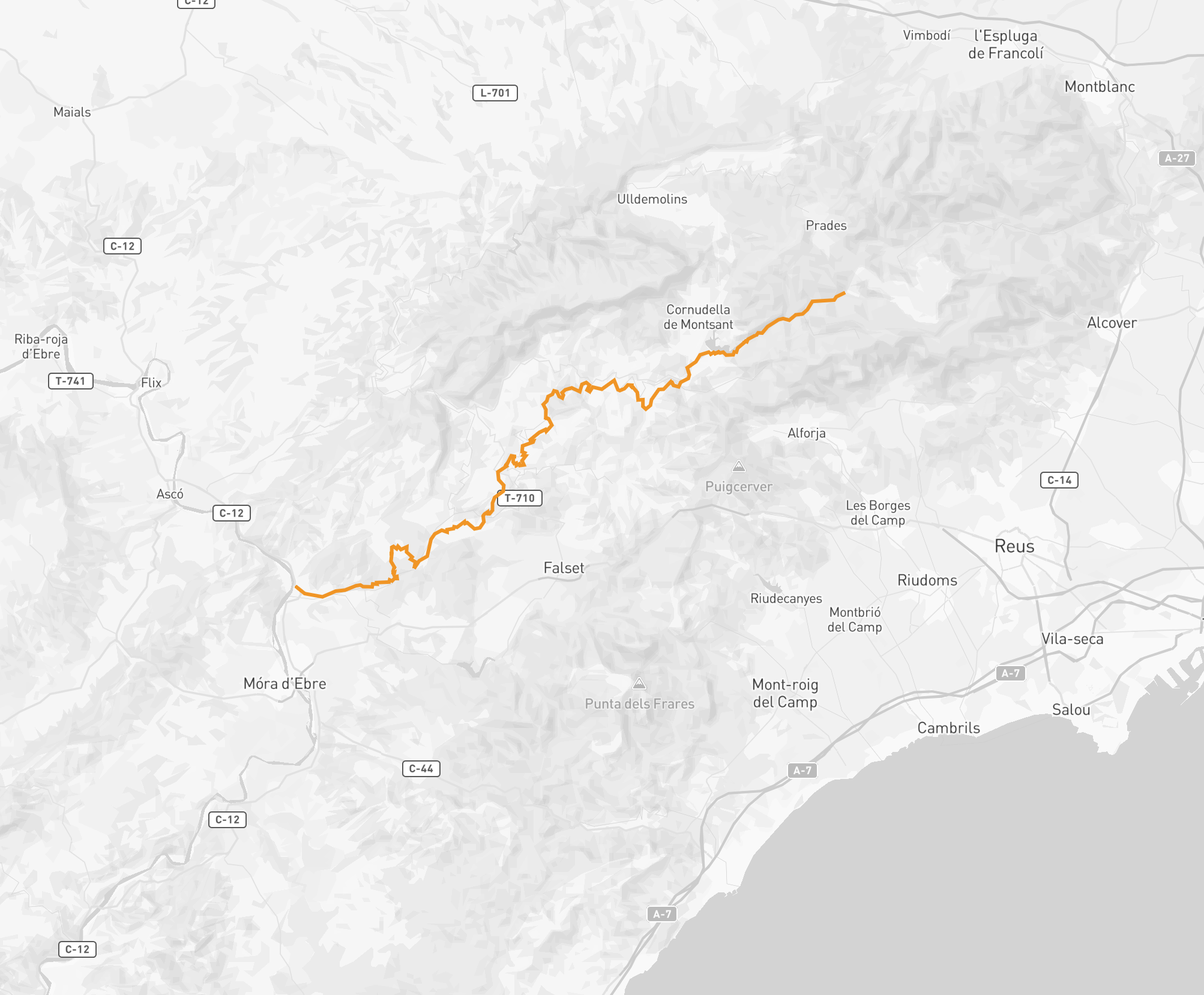
La vora oberta (provisional) | Mapbox
Context
The water transfer between the Siurana river and the Riudecanyes stream is one of Catalonia’s oldest and most persistent water conflicts. Conceived more than a century ago to guarantee the water supply to Reus and its agricultural surroundings, this ten-kilometre tunnel crosses the mountain and diverts almost the entire flow of the Siurana to the Riudecanyes reservoir. In operation since 1950, it has supported the urban and agricultural development of the Baix Camp region, but at the cost of leaving, for much of the year, an exhausted river and a depopulated valley.
The Siurana belongs to the Ebro basin, under state jurisdiction, while Riudecanyes is part of Catalonia’s internal network, managed by the Generalitat. This dual administration—inter-regional and intra-regional—has generated decades of disputes, as the towns of the Priorat demand the recovery of their right to water. The river, which for centuries shaped the agricultural and symbolic life of the region, has been reduced to an intermittent thread of water, unable to sustain either its ecosystem or the new economies linked to the territory, such as nature tourism or wine tourism.
The project starts from this context to question the tensions between territory, body and vital flow: between a land deprived of its water and the forms of life that still resist. What happens when the life of one territory depends on the vital extraction of another? When the flow of one body is interrupted to sustain another, distant one, what kind of bond is created between the two? Is it a transfusion, a transplant, or a form of parasitism? Along its course, the Siurana reveals an anatomy of dependence: a landscape where life persists at the expense of another life.
The project
The project is built around a journey along the entire course of the Siurana river, from its source in the municipality of La Febró (Prades Mountains, Tarragona, 715 m a.s.l.) to its mouth in the Ebro river, near Garcia.
The Siurana runs for some fifty kilometres, crossing the municipalities of Cornudella de Montsant, La Morera de Montsant, Poboleda, Torroja del Priorat, Gratallops, Falset, Bellmunt del Priorat, El Molar, El Masroig and Garcia. A few kilometres before reaching Poboleda, the river loses much of its flow in the transfer to the Riudecanyes reservoir. A canal of about ten kilometres crosses the mountain and carries the Siurana’s water to the Baix Camp, from where it is distributed mainly for agricultural irrigation and the urban supply of Reus and other municipalities of the Camp de Tarragona.
The project proposes to walk the entire course of the river, recording its geography, transformations, and the visible effects of the transfer. This walk, understood as an artistic gesture, becomes a form of symbolic reinscription of the river into the territory. To walk the Siurana—from the spring to its confluence with the Ebro—is to traverse a wound, to follow the line of a body fading out: a vital course interrupted by extraction and loss.