
On the Border
2017/2022
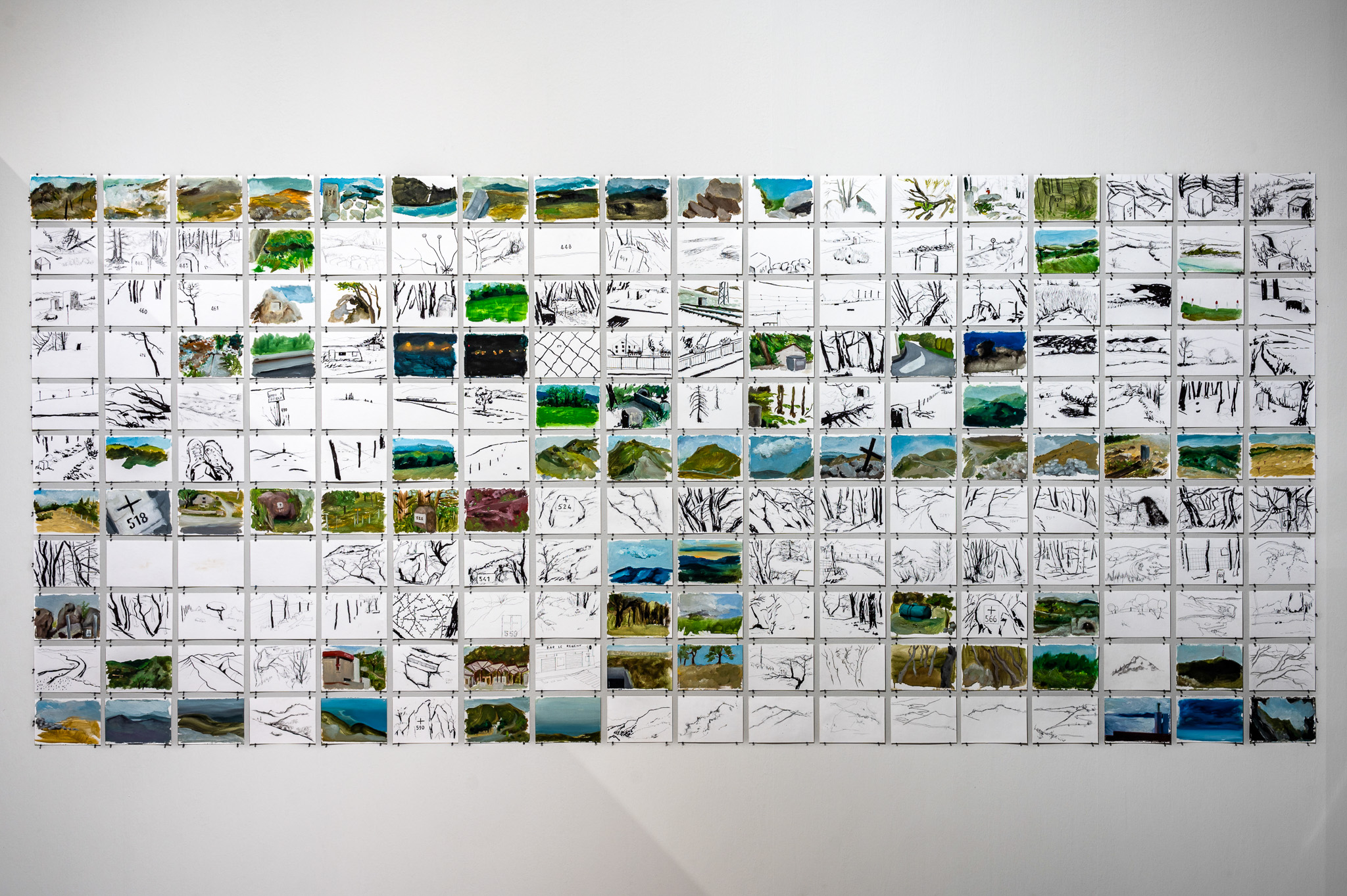
In the summer of 2017, Noris walked the 300 km of the Spanish–French border in the province of Girona, along routes that many Spanish Republican exiles once took. Along the way, the artist made a work corresponding to each of the 198 boundary stones that mark the line. Walking and painting, connecting points along the border—balancing on an invisible line that splits in two what is one—made the invisible visible and unfolded a new landscape of memory.
300 km, 25 days, 198 boundary stones, 212 works. Barcelona Producció 2017 / La Capella.
Texts and paratexts (1)
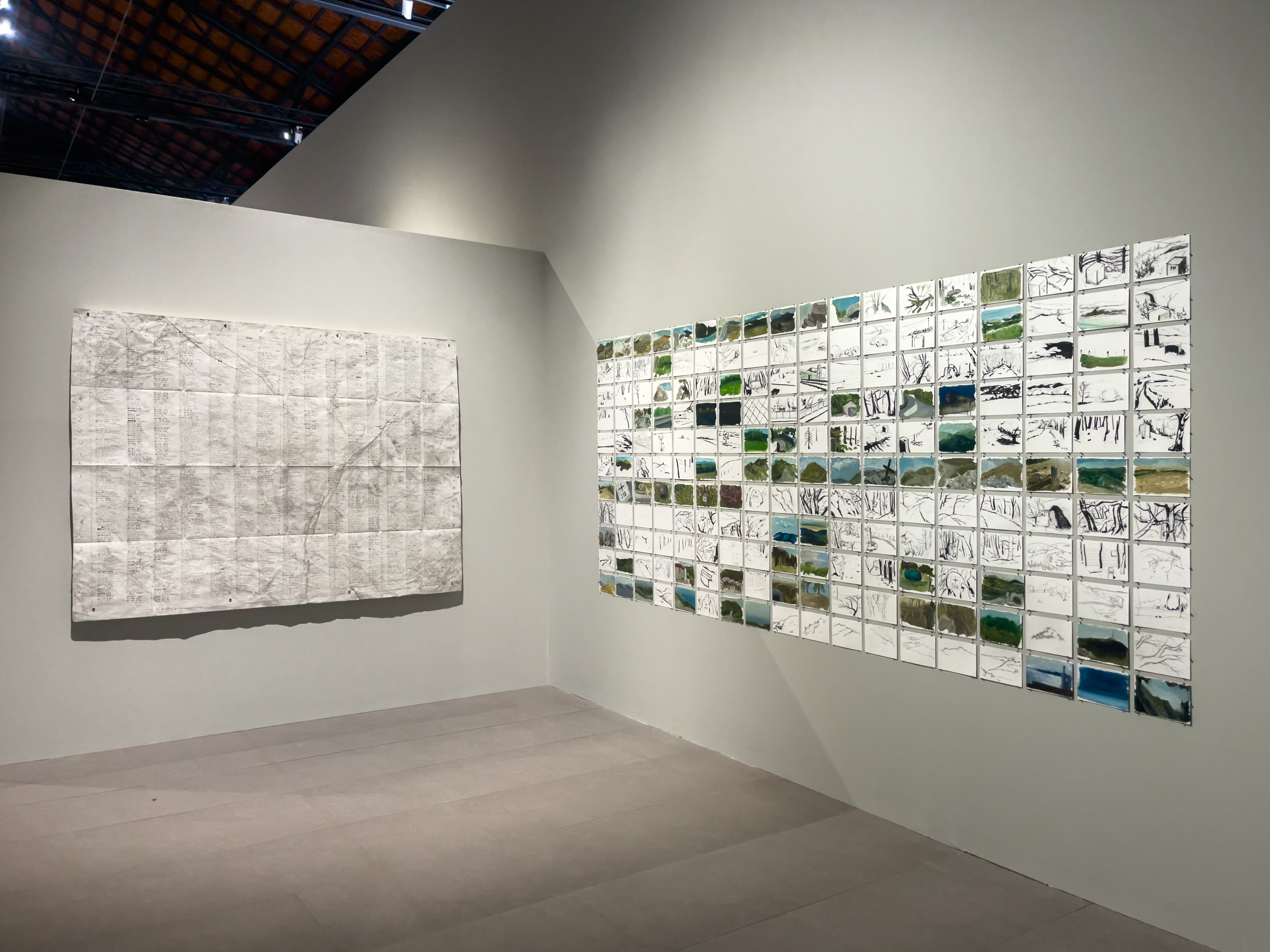
Un altre fi. LA RESTA, El Born CCM, Barcelona, 2022. Installation view. Photos: Pep Herrero
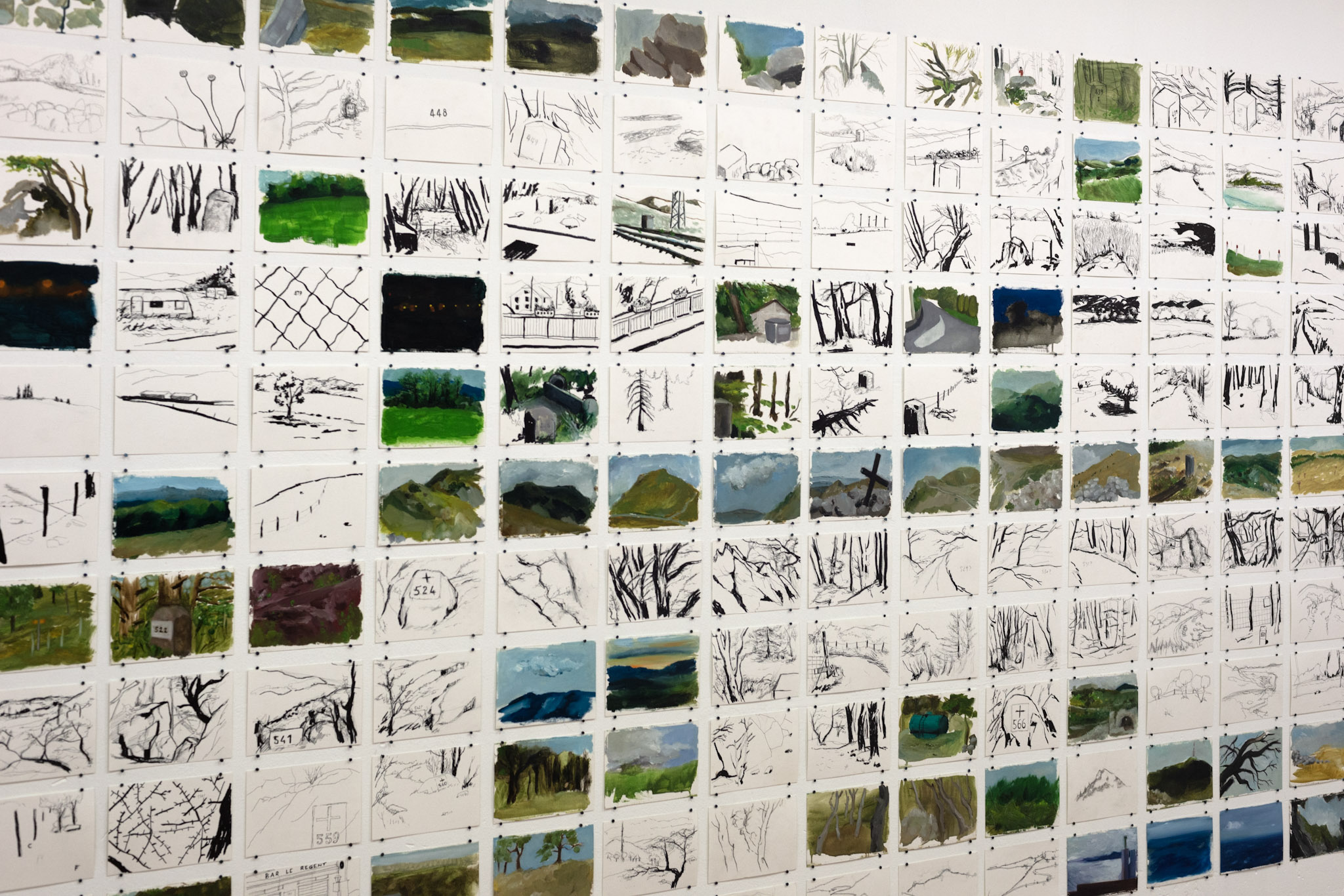
300 km, 25 days, 198 boundary stones, 212 works. Detail. Photos: Pep Herrero
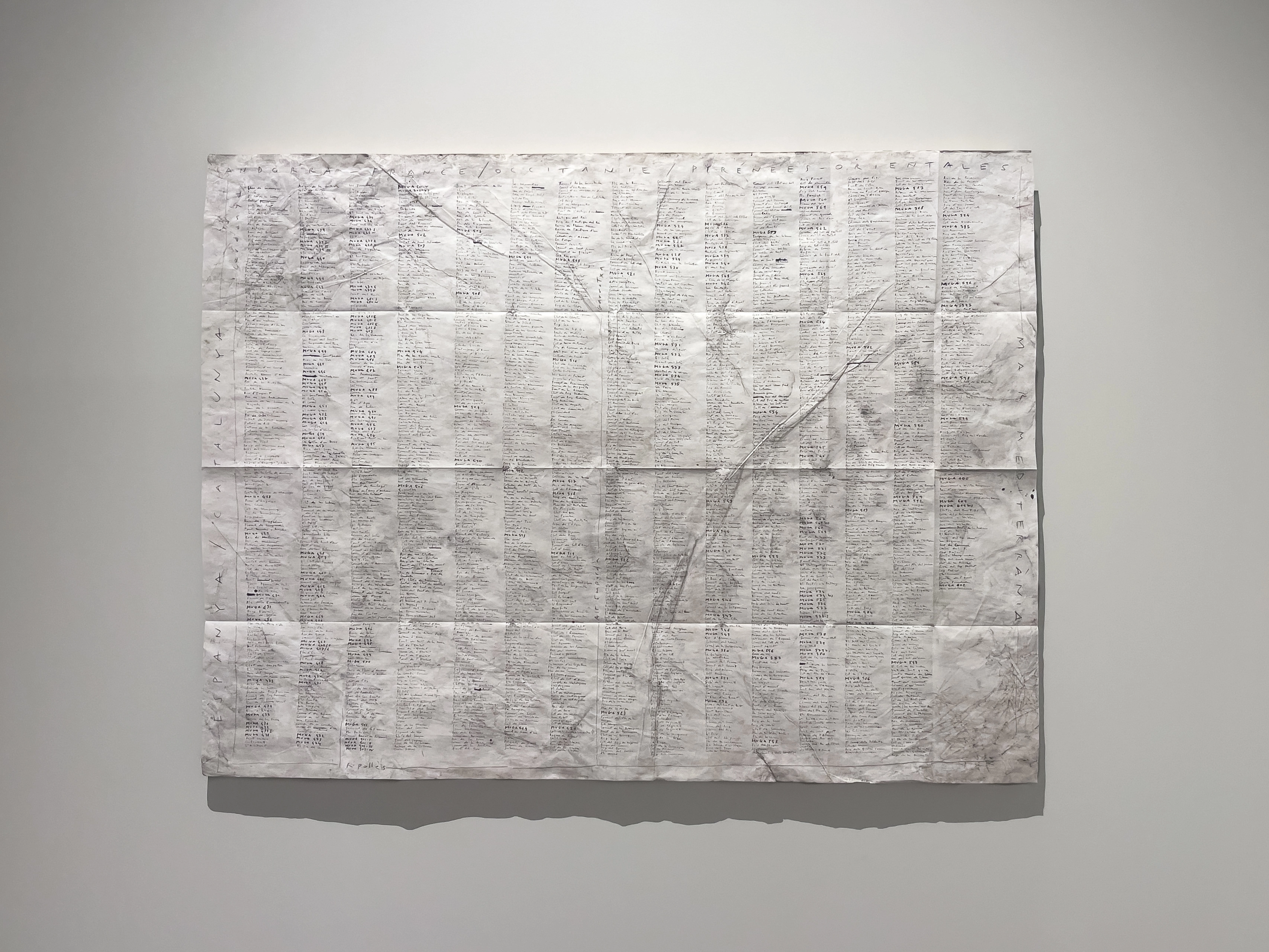

Topònims de frontera (Border toponyms), 2022, mixed media on paper, 150 × 200 cm.
Until the project En frontera, Marco Noris’s pictorial work was developed primarily within the confines of the studio, addressing exile and uprootedness from a position of distance. This project arises from the need for a direct experience, in which the journey does not pursue exclusively a pictorial outcome, but also the lived experience itself: making and being the border through prolonged walking, introspection, and the hardships of the route.
The project took place during the summer of 2017, along the 290 kilometres of the French–Spanish border in the province of Girona, where the main routes of the Spanish Republican exile once passed. During the walk, the artist produced a drawing or an oil painting for each of the 198 mugas1 that mark the boundary line. The traverse lasted 25 days, during which he walked the Pyrenean line from 2,900 metres above sea level down to the coast. The final result was a set of 212 postcard‑format works (12 × 17 cm): 82 oil paintings, 9 mixed‑media works, and 121 drawings.

Photo: Miquel Serrano Jiménez
En frontera is not conceived as a visual documentation of the mugas, but as an emotional recording of the surroundings, shaped by the geographical and environmental conditions of each moment. The practice of plein‑air painting was key to intensifying the relationship with the present and giving the project a strong experiential component. The works are not the goal of the journey, but the trace of an experience oriented toward inhabiting and embodying the border through an introspective route in contact with nature.
Painting each work as if it were a marker and walking connecting points along the border, balancing on that invisible line that splits in two what is one, meant making the invisible visible, unfolding a new landscape of memory.
The route was completed between 18 August and 11 September 2017: 300 km, 25 days, 198 mugas, 212 works. Route and milestones | Mapbox
Credits
- Project and production: Marco Noris
- Planning: Amaranta Amati and Marco Noris
- Logistics and mountain guide: Amaranta Amati
- Mentorship: Alexandra Laudo
- 3D printing: Patricio Rivera
- Walkers: Paula Bruna, Natalia Carminati, Núria Casas, Joana Cervià, Albert Coma, Claudia Godoy, Alexandra Laudo, Jordi Martinez‑Vilalta, Josep Rubio, Miquel Serrano, William Truini
-
Support and transport: Kike Bela, Joana Cervià, Josep Rubio, Marc Ferrer‑Dalmau and Alex Nogueras, Roberto Noris and Ana Lorente
-
Special thanks to Amaranta Amati, Alexandra Laudo and the entire Barcelona Producció jury; to Roberto and Ana, Joana Cervià and Josep Rubio, Kike Bela, Patricio Rivera, Alex Nogueras and Marc Ferrer‑Dalmau, Cayetano Martínez, Miquel Serrano and Jordi Font at MUME.
- Thanks also to Josep Estruch and Montserrat Rectoret Blanch, Rebeca Arquero, Clara Garí and El grand tour, Marc Badia, Xavier Aguilò, Jordi Martinez‑Vilalta, Claudia Godoy, Natalia Carminati, William Truini, Nuria Casas, Paula Bruna, Albert Coma, Ferrán Latorre, Carmen Sánchez, Pere Llobera, Zuriñe Etxebarria, Jordi Pi and the Club Excursionista de Gràcia, La Capella, Hangar.org, Piramidón.
Project produced with the support of BCN Producció 17. La Capella, Institute of Culture of Barcelona.

-
Muga (“boundary stone”) is a word of Basque origin used in the Catalan Pyrenees instead of mojón (or hito, in Spanish) and fita (in Catalan). Although it comes from Euskara, the term is also recorded by the Royal Spanish Academy and is used in Spanish with the same meaning: “boundary or border between territories.”
Here you can find an article written in Catalan by Josep Estruch for On the Border about the etymology of the word. ⤶